


Philanthropy has a trillion-dollar blind spot
Philanthropy has a trillion-dollar blind spot

Badr JafarSun, November 8, 2026 at 2:44 PM UTC
0
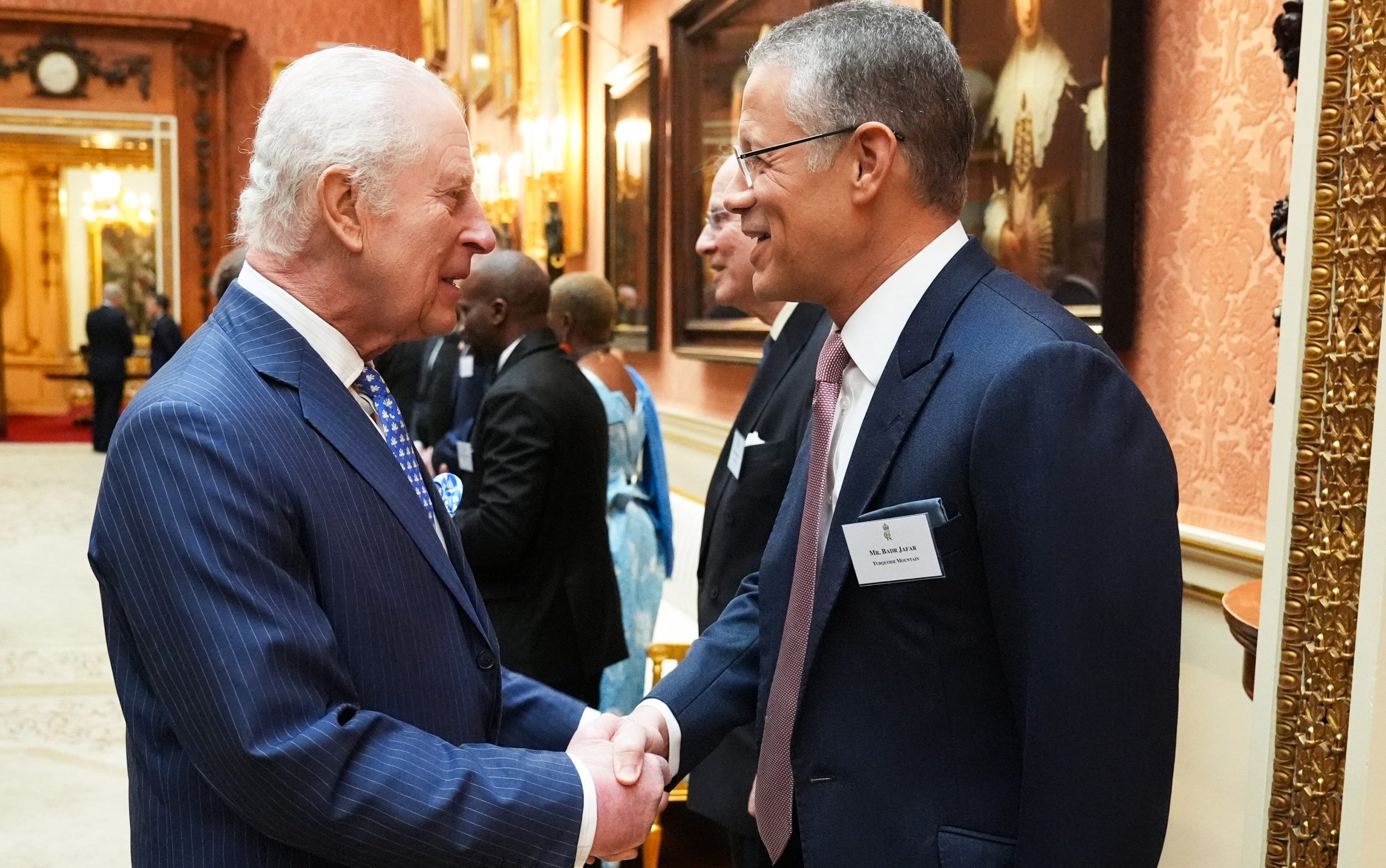
The King and King Badr Jafar last year. The special envoy is calling for Britain and the UAE to work together in coordinating charity donations - AFP via Getty Images/Aaron Chown
Humanity now gives away close to $2.5tn (£1.9tn) a year, roughly 3 per cent of global economic output. Were global giving a national economy, it would rank among the 10 largest in the world. There has never, in absolute terms, been a more generous era. Yet ask the harder question – how much of that generosity actually changes lives? – and the answer should give us pause. The real gap in giving today is not a gap in capital. It is a gap in impact: too little of what we give ever reaches the hundreds of millions who remain left out, unseen and too easily forgotten.
That gap is about to matter far more. Public finances everywhere are stretched between security, debt and ageing societies, and official aid worldwide has just recorded what the OECD itself calls a historic decline. That is not a judgment on any government’s choices; it is arithmetic. But the consequence is unavoidable: private giving can no longer be a supplement to public action. Across much of the world, it is becoming the front line.
This makes philanthropy’s oldest weakness newly dangerous. Philanthropy is the forgotten child of the capital system. Commercial capital is scrutinised with extraordinary rigour by boards, auditors, analysts, and markets. Public spending answers to parliaments and electorates. Philanthropic capital is rightly celebrated for its generosity and rarely examined for its impact. Generosity is the easy part. Giving becomes powerful only when it is practised with the same rigour, discipline and accountability we demand of every other form of capital.
The most durable impact rarely comes from handing out fish. Nor even from teaching people to fish. It comes from improving the conditions in which responsible fishing can thrive. Understood this way, philanthropy is not simply a moral impulse; it is a structural one, the first-loss capital without which the wider system cannot function. It has the potential to absorb early risk, prove what works, and crowd in commercial and public money at many times its own scale. Public policy sets the direction; philanthropy de-risks the experiment; business scales what works. Call it the impact flywheel, and each turn regenerates confidence across the whole system.
I make no claim that my own region has perfected any of this. Nevertheless, this spring, even as our part of the world was tested, the people of the United Arab Emirates (UAE) came together behind the Edge of Life campaign launched by our prime minister, raising the equivalent of nearly £600m in a matter of weeks to help rescue five million children from hunger in some of the most vulnerable places on Earth. What stayed with me was not the number. It was the coordination: government, business, families and faith institutions pulling in one direction, a glimpse of what giving can achieve when it is organised, not merely inspired.
Giving in our part of the world did not begin with modern philanthropy; it is rooted in centuries of zakat, sadaqah and waqf. Today, Gulf philanthropic capital is among the most significant anywhere, values-driven, patient and increasingly strategic, with private giving estimated at more than £150bn a year. What it still lacks, what every region still lacks, is the connective tissue: the platforms, standards and partnerships that turn generous intent into measured outcomes. That is what the UAE is now working to help build as it bridges geographies where both the need and the next generation of givers are growing fastest, across Asia and Africa.
Advertisement
Britain holds the other half of the answer. It has more than 170,000 registered charities, a tradition stretching back to mediaeval almshouses, with a sector income approaching £100bn a year. Courts, regulators, trustees and advisers refined over centuries: the infrastructure of trust that is the essential currency of civil society. No other country has built anything quite like it.
So here is the proposition: Britain and the UAE should stop being imagined as rivals for the same capital and start operating as twin hubs: two trusted platforms in two complementary corners of the world. London brings institutions, expertise and global reach. The UAE brings its agility, convening power, and position at the crossroads of the rising world. Between us, we can convene and coordinate strategic giving across every geography that needs it, not as competitors, but as the bridges through which the world’s generosity finally becomes the world’s impact.
The timing will not wait. More than $100tn is set to pass between generations in the coming decades, much of it into the hands of inheritors asking sharper questions about purpose and impact than any generation before them. The money, in other words, is already there. What is missing is the architecture to direct it with the rigour we would apply to any other trillion-dollar asset class.
Building that architecture together is the work ahead.
The founding father of the UAE, the late Sheikh Zayed, believed the greatest use of wealth is not to display it, store it or guard it across generations, but to invest it in people. Wealth, at its best, is not a destination. It is a vehicle. It is time we built the roads.
Badr Jafar is the Special Envoy of the UAE Foreign Minister for Business and Philanthropy. He delivered the keynote at the third Giving and Impact Summit, at the London Stock Exchange, in June.
Source: “AOL Money”
